
You already know something is wrong. Maybe you felt the bulge weeks ago. Maybe it’s been months of discomfort you’ve been managing, adjusting around, hoping it settles. It won’t. Hernias don’t go away on their own.
Hernia surgery in Hisar is more accessible and more advanced than most people realise. And getting it done properly, by the right surgeon, in the right setup, makes a bigger difference to your recovery than anything else.
This is what you need to know before you book.
What is a Hernia?
Brief, because you probably already know the basics.
A hernia happens when an organ or fatty tissue pushes through a weak spot in the surrounding muscle wall. Usually the abdomen. Sometimes the groin. Occasionally near an old surgical scar. The result is a bulge you can sometimes see, sometimes only feel, and pain that ranges from a dull ache to something sharp and sudden.
- Inguinal hernia– groin area, most common type, more frequent in men
- Umbilical hernia– around the navel, common in adults and children
- Incisional hernia– at the site of a previous surgical incision
- Hiatal hernia– upper stomach pushes into the chest through the diaphragm
Left untreated, hernias don’t stabilise. They grow. They get complicated. And a complicated hernia is a much harder surgical problem than a simple one caught early.

Can Hernia Surgery Be Minimally Invasive?
Yes. For most hernia types, it’s now the preferred approach.
Hernia Surgery in Hisar, Laparoscopic Repair
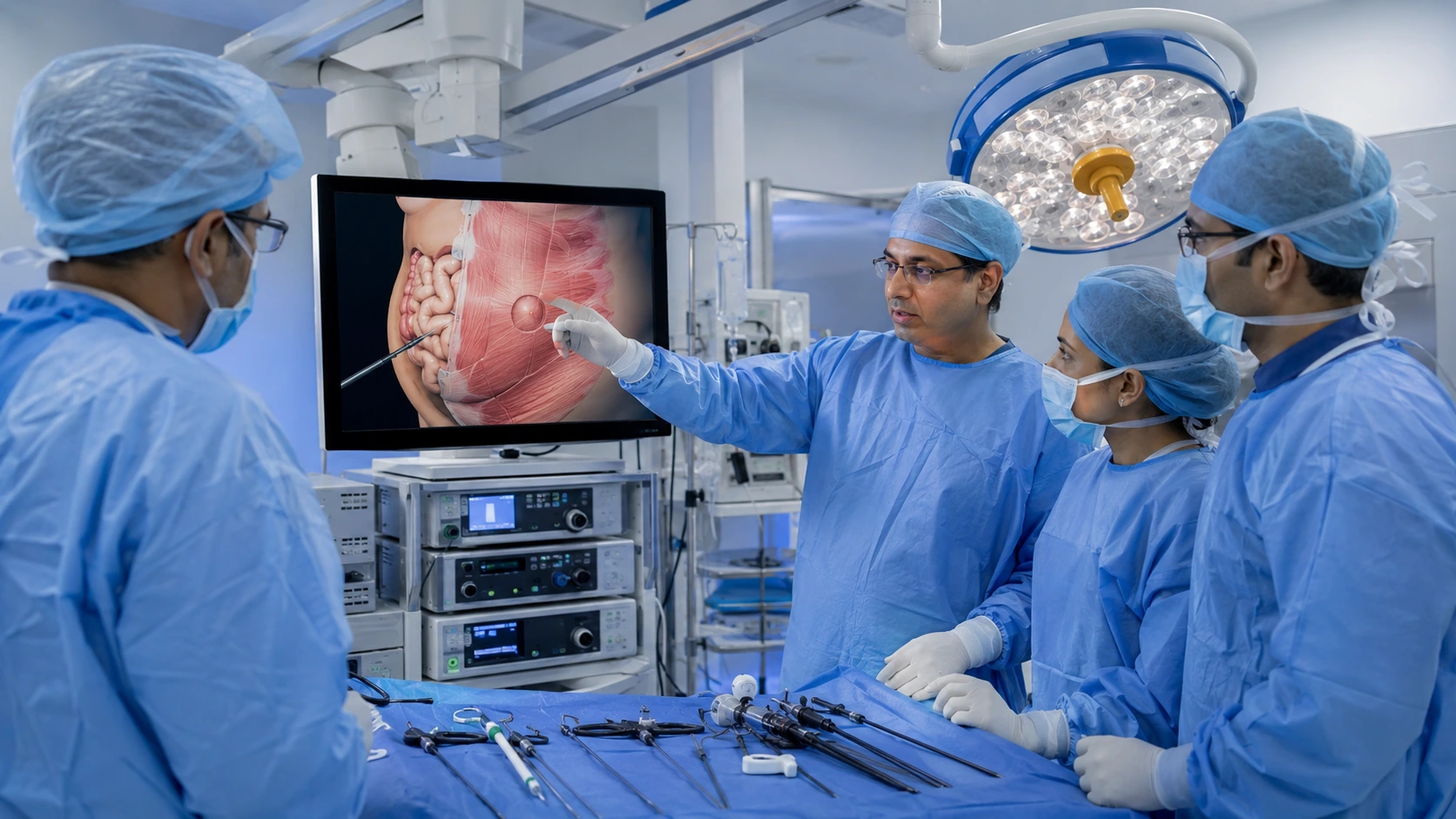
Laparoscopic hernia repair, that’s the minimally invasive version, uses small incisions instead of one large cut. A tiny camera goes in, the surgeon views everything on a high-definition screen, and the repair is done with precision instruments designed specifically for this. Mesh is placed to reinforce the weak area.
The incisions are closed. Usually three small marks total.
What that means for recovery is significant.
Most patients are up and walking the same day. Discharged within 24–48 hours. Back to light activity within a week. The difference compared to open hernia surgery isn’t marginal, it’s the difference between two weeks of real discomfort and two weeks of barely noticing the recovery.
Not every hernia can be repaired laparoscopically. Some are too large, some involve anatomy that makes laparoscopy unsafe, some patients have surgical histories that change the picture. A proper assessment before the procedure determines which approach is right for you.
Hernia Surgery in Hisar, When Open Surgery is Needed
Sometimes open surgery is the right call. Large or complex hernias. Recurrent hernias where previous mesh complicates the anatomy. Emergency presentations where the hernia has become strangulated, meaning the trapped tissue has lost blood supply and time matters.
At Meyash Hospital, both approaches are available. The decision is clinical, made based on your specific hernia, your history, and what will give you the safest, most durable repair.
Causes of Hernia
Hernias don’t always have a single identifiable cause. Usually it’s a combination, an underlying weakness in the muscle wall, plus pressure that pushes tissue through it.
Common contributing factors:
- Chronic straining, from constipation, heavy lifting, persistent coughing
- Pregnancy, increases abdominal pressure significantly over months
- Previous abdominal surgery, incisions create permanent areas of relative weakness
- Obesity, sustained elevated intra-abdominal pressure
- Age, muscle tissue naturally weakens over time
- Congenital weakness, some people are born with a predisposition
Knowing the cause matters less than addressing the hernia. But understanding it helps with post-surgical prevention, reducing the factors that created the problem in the first place.
Symptoms That Shouldn’t Be Ignored
A bulge that appears when you stand or strain and disappears when you lie down. That’s the classic presentation. But hernias don’t always announce themselves that clearly.
Watch for:
- A lump in the groin, abdomen, or navel, soft, sometimes pushes back in
- Aching or dragging discomfort, especially after standing for long periods
- Pain that worsens when you cough, bend, or lift
- A feeling of heaviness or pressure in the lower abdomen
- Sudden severe pain with a hernia that won’t push back, this is an emergency
That last one. If a hernia becomes hard, extremely painful, and won’t reduce, go immediately. That’s strangulation. It needs surgery the same day.
Which Doctor is Best for Hernia Surgery?
Dr. Yashpal Singla has performed a significant volume of hernia repairs, laparoscopic and open, straightforward and complex, first-time repairs and revisions. Inguinal hernias, umbilical hernias, incisional hernias, recurrent cases that come in after a previous repair elsewhere has failed.
That last category matters. Recurrent hernias are harder. The anatomy is altered. Scar tissue changes everything. Handling them well requires a specific depth of experience, not just familiarity with the technique.
What patients consistently say about him, he explains the situation clearly, doesn’t rush the pre-surgical conversation, and is available post-operatively when questions come up. That’s not a small thing. Surgery creates anxiety. Knowing your surgeon is reachable after discharge changes the recovery experience.

Diagnosis, What Happens Before Surgery
You don’t come in and go straight to the OT. A proper assessment happens first.
- Physical examination, the surgeon feels for the hernia, checks its size, whether it reduces, whether there are signs of complication
- Ultrasound, confirms the diagnosis, rules out other causes of the lump or pain
- CT scan, for complex, recurrent, or large hernias where detailed anatomy is needed before planning the repair
- Hernia assessment, size, type, content, reducibility, all inform the surgical approach
The assessment isn’t a formality. It determines everything about how the surgery is done.
Treatment at Meyash Hospital, What to Expect
Hernia surgery in Hisar at Meyash Hospital is planned around your specific case.
For laparoscopic repair, three small incisions, mesh placement under direct vision, repair completed in 45–90 minutes typically. You’re monitored post-operatively, mobile by evening, discharged the next day in most cases.
For open repair, larger incision directly over the hernia site, mesh placed, wound closed in layers. Used for hernias where laparoscopy isn’t appropriate. Recovery takes slightly longer but is still manageable with proper aftercare.
Both approaches at Meyash use high-quality mesh, the material matters for long-term outcomes and hernia recurrence prevention. Cheap mesh fails. Good mesh, correctly placed, lasts decades.
The anaesthesia team here is experienced specifically in abdominal and laparoscopic procedures. The post-op care doesn’t stop when you leave the OT, monitoring continues, pain management is handled, and discharge happens when you’re genuinely ready, not on a fixed timeline.
Recovery After Hernia Surgery
What most patients want to know, how soon can I get back to normal?
Laparoscopic repair:
- Day 1, walking, eating light, soreness manageable
- Week 1, light activity at home, wound healing well
- Week 2–3, gradual return to normal routine
- Week 6, cleared for heavier activity, exercise, full physical work
Open repair:
- Recovery is slightly longer, 4–6 weeks before strenuous activity
- Pain managed with oral medication for the first week
- Follow-up at one week and one month to track healing
What derails recovery, going back to heavy lifting too soon. The mesh needs time to integrate with surrounding tissue. Pushing before that window is how hernia recurrence happens.
Prevention, Reducing the Risk of Recurrence
Surgery fixes the hernia. Prevention is about not creating the conditions for another one.
- Avoid straining during bowel movements, high-fibre diet, hydration, don’t rush
- Lift correctly, bend at the knees, brace the core, never jerk suddenly
- Manage weight, sustained abdominal pressure is the recurring underlying factor
- Treat chronic cough, persistent elevated pressure tears at repairs over time
- Follow surgical restrictions completely during recovery, the six-week rule isn’t arbitrary
Conclusion
A hernia sitting there getting bigger isn’t a waiting strategy, it’s a risk accumulating. Hernia surgery in Hisar at Meyash Hospital is precise, minimally invasive where appropriate, and followed through properly. Dr. Yashpal Singla has done enough of these to make the difficult ones look simple and the simple ones genuinely smooth.
If you’ve been putting this off, this is the prompt to stop.
Book Your Hernia Surgery Consultation at Meyash Hospital
Don’t let a manageable hernia become a complicated one. Meyash Hospital, Hisar offers advanced laparoscopic hernia repair with expert surgical care from Dr. Yashpal Singla. Book your consultation today and get a clear plan.
Frequently Asked Questions
Q1: Is a hernia 100% curable with surgery?
Surgery is the only definitive treatment for hernia, it won’t resolve on its own. Success rates for hernia repair are high, particularly with laparoscopic technique and quality mesh. Recurrence is possible but uncommon when the repair is done correctly and post-surgical guidelines are followed during recovery.
Q2: What is the 6-2 rule for hernia?
The 6-2 rule refers to post-hernia surgery restrictions, avoid lifting anything heavier than 2 kilograms for the first 6 weeks after repair. This allows the mesh to fully integrate with surrounding tissue before it bears any real load. Violating this window is one of the most common reasons hernias recur after surgery.
Q3: How do I know if my hernia needs surgery urgently?
If the hernia becomes suddenly hard, extremely painful, and cannot be pushed back in, that’s strangulation, a surgical emergency. Go immediately. For non-emergency hernias, the timing is elective but shouldn’t be delayed indefinitely. Larger hernias are harder to repair and carry higher complication risk than smaller ones caught early.
Q4: What type of mesh is used for hernia repair at Meyash Hospital?
Meyash Hospital uses high-quality synthetic mesh for hernia repair, the material is durable, biocompatible, and designed for long-term integration. Mesh selection is part of the surgical planning process and varies based on hernia type, size, and patient factors. Your surgeon will explain the specific choice before the procedure.
Q5: Can a hernia come back after laparoscopic repair?
Recurrence is possible but less common with laparoscopic repair compared to open surgery, particularly for inguinal hernias. Risk is reduced by quality mesh placement, appropriate technique, and following post-operative restrictions carefully. Smoking, obesity, and returning to heavy activity too soon are the main factors that increase recurrence risk.
Q6: How soon can I return to work after hernia surgery in Hisar?
For desk-based or light work, typically 1–2 weeks after laparoscopic repair. For physical or manual labour, 4–6 weeks minimum, following clearance from your surgeon. Hernia repair recovery timelines are individual, your surgeon sets the schedule based on your specific procedure and healing progress.

