
Not every hernia is an emergency. Plenty of people live with a small one for years under a doctor’s eye. But some hernias turn dangerous fast, and knowing the difference can genuinely save you. The clearest signs your hernia needs surgery are sudden or severe pain, a bulge that won’t push back in, a lump that turns hard, skin that changes colour over it, and vomiting.
If any of those show up, you need a doctor quickly. Here are the seven warning signs, explained plainly, so you know exactly when to act.
A Quick Word on What a Hernia Is
A hernia happens when an organ or some tissue pushes through a weak spot in your muscle wall, usually showing up as a bulge you can see or feel. The common spots are the groin, the belly button, and the site of an old surgery. Most start out small and painless, which is why people tend to ignore them.
The trouble is they can grow and cause problems over time, so knowing the signs your hernia needs surgery matters even if yours feels harmless right now.
Why Some Hernias Suddenly Become Serious
Here’s the part that explains all seven signs below. A hernia turns into an emergency when the tissue pushing through gets trapped and its blood supply gets cut off. Doctors call this strangulation, and it’s exactly as serious as it sounds. Without quick treatment, that trapped tissue starts to die, which leads to severe complications.
Spotting the early warning signs is what keeps a manageable hernia from becoming a midnight trip to the emergency room. Understanding the signs your hernia needs surgery can help you seek treatment before a serious complication develops.
The 7 Signs Your Hernia Needs Surgery Immediately
Watch closely for these signs your hernia needs surgery:
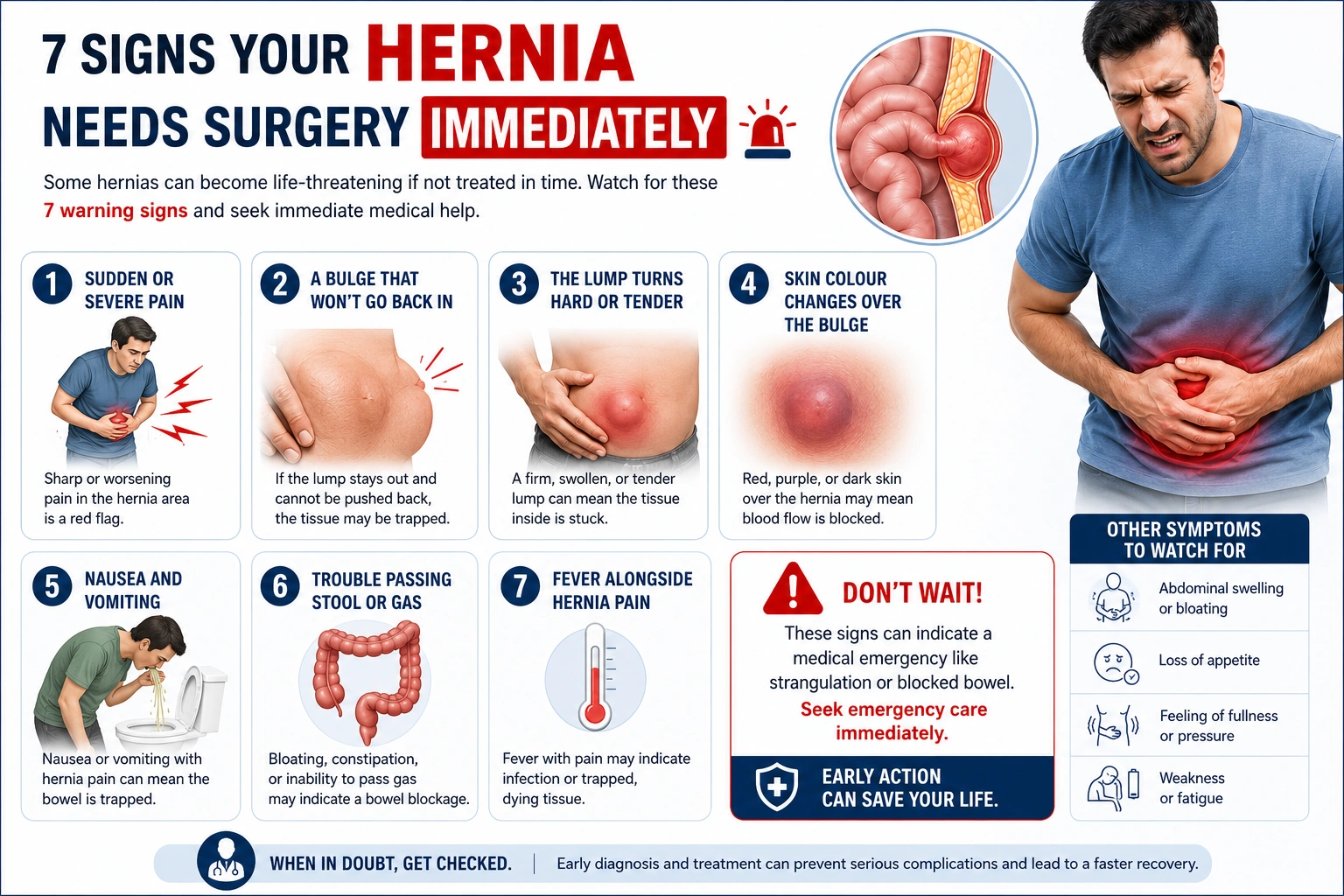
1. Sudden or Severe Pain
A hernia that’s been quietly sitting there and then suddenly hurts, especially sharp pain or pain that keeps getting worse, is a red flag. Mild, occasional discomfort is one thing. Intense pain that comes on fast is another, and it needs attention right away.
2. A Bulge That Won’t Go Back In
Normally a hernia bulge softens or slips back when you lie down or press it gently. If the lump stays out and simply won’t go back no matter what, the tissue may be trapped. This is one of the most telling signs your hernia needs surgery without delay.
3. The Lump Turns Hard or Tender
If the bulge becomes firm, swollen, or sore to the touch when it used to be soft, take it seriously. A hard, tender lump often means the tissue inside is stuck, and that needs medical care quickly.
4. Skin Colour Changes Over the Bulge
Keep an eye on the skin over the hernia. If it turns red, purple, or dark, that’s a warning that blood flow is being choked off. Don’t wait this one out. Get to a doctor straight away.
5. Nausea and Vomiting
Feeling sick or actually vomiting alongside hernia pain is a worrying combination. It can mean the bowel is blocked or trapped inside the hernia. This is an emergency, not something to sleep on.
6. Trouble Passing Stool or Gas
If you can’t pass stool or gas, your belly feels bloated, and there’s pain with it, the hernia may be blocking your intestine. That needs to be checked immediately, because a blockage doesn’t resolve on its own.
7. Fever Alongside Hernia Pain
A fever turning up with a painful hernia can point to infection or trapped, dying tissue. Pain plus fever is a combination you should never brush off. Treat it as a reason to seek care now.
When to See a Doctor
Even without a full-blown emergency, see a doctor if your hernia is growing, getting uncomfortable, or starting to interfere with daily life. Treating it early is simpler, and recovery is easier when you’re not dealing with a crisis.
But if you spot any of the seven signs above, especially severe pain, vomiting, or that skin colour change, don’t wait for an appointment. Go for emergency care. Acting fast in those moments is what prevents a hernia from becoming life-threatening.
Who Is Most Likely to Develop a Hernia?
Some people are simply more prone to hernias than others, and knowing whether you’re in that group makes you quicker to spot the signs your hernia needs surgery if one ever forms. Men get hernias more often than women, particularly groin hernias. Age plays a part too, since muscle naturally weakens over the years.
Other things raise the odds. Jobs or hobbies involving heavy lifting put repeated strain on the muscle wall. A chronic cough, long-term constipation, pregnancy, and being overweight all do the same. Previous abdominal surgery can leave a weak point where an incisional hernia later develops.
If a few of these apply to you, it’s worth being extra alert to any new bulge or discomfort, because catching a hernia early keeps your options simple.
How a Hernia Is Diagnosed

Most hernias are diagnosed with a straightforward physical exam. The doctor feels the area and usually asks you to cough or stand, since that makes the bulge pop out more clearly. If they want a closer look, especially to judge how serious things are, an ultrasound, CT scan, or MRI confirms the size and type.
That information helps the surgeon choose the safest, most effective treatment for you rather than guessing.
Treatment Options for a Hernia
Once the signs your hernia needs surgery are clear, the good news is the fix is well established. For most hernias, surgery is the only permanent solution. There are two main routes. Laparoscopic, or keyhole, repair uses a few tiny cuts and a camera, while open repair uses one larger cut.
Both strengthen the weak muscle wall, almost always with a mesh that supports the area like a patch.
Keyhole surgery usually means less pain and a quicker recovery, which is why it suits a lot of people. Open surgery is often the better choice for very large or complicated hernias. In a true emergency, where tissue is trapped, surgery happens urgently and the surgeon picks the safest approach for the situation.
Your surgeon will talk you through the right option after examining you.
Can You Prevent a Hernia From Getting Worse?

You can’t always stop a hernia forming, but you can avoid making an existing one worse while you wait for treatment. Don’t lift heavy things, since straining pushes more tissue through the weak spot. Treat a stubborn cough or constipation, because both put repeated pressure on the area.
Keeping to a healthy weight helps too, as extra weight adds strain on the muscle wall.
None of this fixes the hernia, to be clear. It only buys you safer time until surgery. The repair itself still has to come from an operation.
Conclusion
A hernia isn’t always urgent, but the signs your hernia needs surgery are worth memorising, because when they appear, time matters. Sudden severe pain, a bulge that won’t go back, a hard or tender lump, skin turning red or dark, vomiting, no stool or gas, and fever with pain.
Any of these means stop waiting and get medical help, because they can point to trapped tissue losing its blood supply. Even a calm, painless hernia deserves a doctor’s eye, since the only real cure is surgery and earlier is always easier. Trust your gut. If something about your hernia suddenly feels wrong, it’s far safer to get checked than to hope it passes.
At Meyash Hospital, our experienced surgical team offers advanced laparoscopic and open hernia repair with a focus on safety and comfort. We diagnose quickly and recommend the right treatment for lasting relief. With modern facilities, skilled surgeons, and minimally invasive techniques, we help you recover faster and get back to normal life.
This article is reviewed by the expert team at Meyash Hospital. If you are experiencing symptoms, consult the specialists Dr. Yashpal Singla with 15+ years of experience for expert diagnosis and advanced treatment.
Frequently Asked Questions (FAQs)
Q.1 What are the most urgent signs your hernia needs surgery?
The most urgent are severe pain, a bulge that won’t push back in, a hard lump, skin colour changes, vomiting, and fever. Any of these means emergency care.
Q.2 Can a hernia heal without surgery?
No, hernias don’t heal on their own. Surgery is the only permanent treatment, though a small painless one may be watched closely by a doctor for a while.
Q.3 Is a painless hernia still dangerous?
A painless hernia is usually less urgent, but it can grow and become serious over time. Regular monitoring by a doctor is the safe approach.
Q.4 How quickly should I act on the warning signs?
If you have severe pain, vomiting, or a hard, discoloured bulge, seek emergency care immediately. These can be life-threatening if left.
Q.5 What happens if a hernia is left untreated?
An untreated hernia can grow, start hurting, and in serious cases lead to a blocked or strangulated bowel, which is a medical emergency.

