
There’s a particular kind of worry that sits with you when surgery is on the table. Not panic exactly. More like a low hum. You keep pushing the decision forward. One more week. Let me just see if it gets better. It doesn’t get better. It gets more complicated.
If you’ve been told you need a hernia surgery in Hisar, or you’ve suspected it for a while and kept postponing, this article is for you. Not to scare you. To help you understand what the operation actually involves, what recovery genuinely looks like, and why getting it done at the right place changes everything.
What Happens During a Hernia Operation?
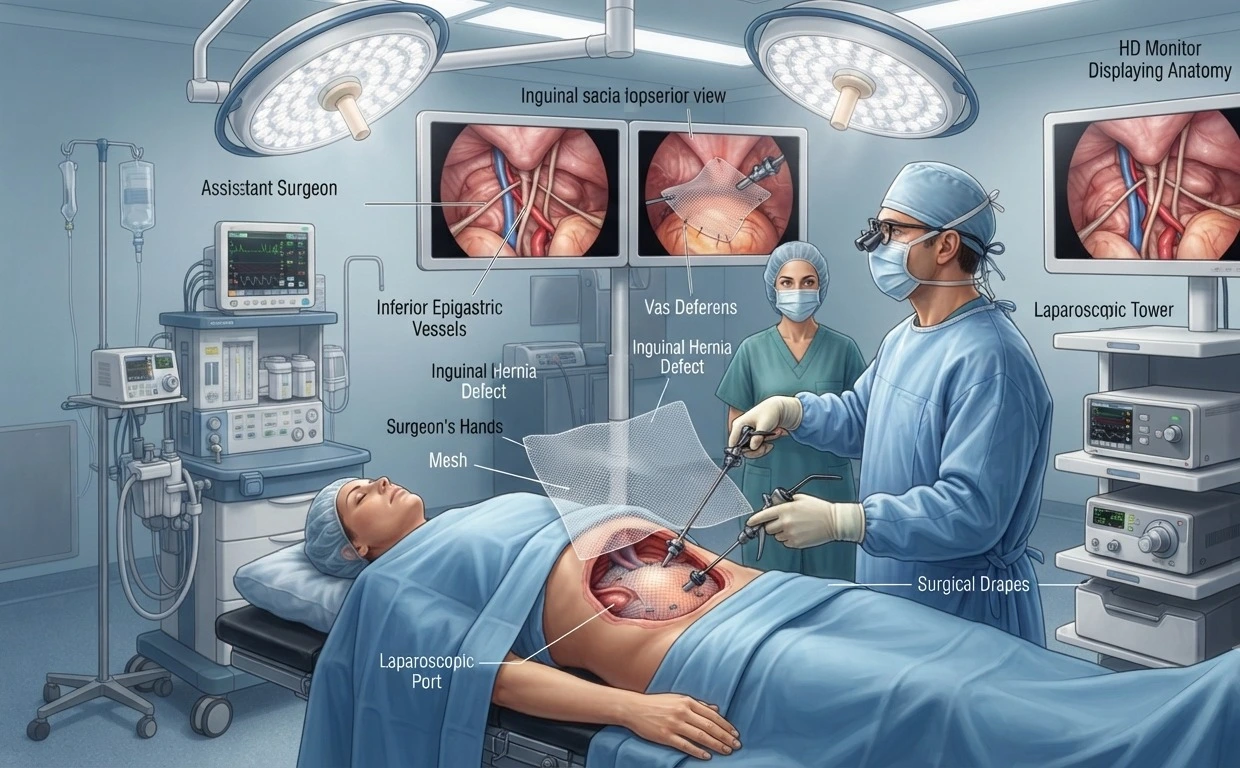
The operation itself is shorter than most people imagine. And far less dramatic than what anxiety tends to build it up to be.
A hernia operation in Hisar at Meyash Hospital is performed one of two ways, laparoscopic or open, depending on the type and complexity of your hernia.
Hernia Operation in Hisar, Laparoscopic Approach
Three small incisions. A camera. Specialised instruments. The surgeon works with a clear high-definition view of everything, repairs the weak spot, places a mesh to reinforce it permanently. The whole thing typically takes 45–75 minutes. You wake up, you’re sore but mobile, and most patients go home the next day.
That’s the laparoscopic route, and for most inguinal, umbilical, and straightforward incisional hernias, it’s the preferred approach at Meyash Hospital. Less cutting means less healing. Simple as that.
Hernia Operation in Hisar, Open Approach
One larger incision directly over the hernia site. The repair is done directly, mesh placed, wound closed in layers. Recovery takes a bit longer. But for large hernias, recurrent hernias, or cases where previous surgeries have altered the anatomy, open surgery is sometimes the right call, and done well, it’s just as effective.
The approach isn’t arbitrary. It’s chosen based on your specific hernia after a proper pre-surgical assessment. What matters is that both options are available here, and the decision is clinical, not based on what’s easier or faster for the surgeon.
Is Hernia Surgery a Serious Surgery?

This is what everyone wants to ask but sometimes feels awkward saying out loud.
Hernia Operation in Hisar, Understanding the Risk Honestly
The risks exist. They’re real. They include anaesthesia reactions, wound infection, bleeding, hernia recurrence, and in rare cases, nerve or surrounding structure involvement. Your surgeon should tell you all of this before you go in. Dr. Yashpal Singla does. That’s part of what informed consent actually means—not just a form you sign, but a conversation you have before hernia surgery in Hisar.
Honestly? It’s a real surgery. Hernia surgery in Hisar requires anaesthesia, a sterile operating environment, a skilled surgical team, and post-operative monitoring. Those things are serious by nature. Anyone who tells you hernia surgery is “completely minor, nothing to worry about” is dismissing a legitimate concern.
At the same time, hernia surgery in Hisar, like hernia repair performed worldwide, is one of the most commonly performed surgical procedures. Hundreds of thousands are carried out every year. The technique is well-established, the risks are well-understood, and in experienced hands at a properly equipped hospital, complications are uncommon.
What makes hernia surgery in Hisar feel more serious than it needs to be is choosing the wrong surgeon, the wrong hospital, or waiting until the hernia becomes strangulated and surgery becomes an emergency. A planned hernia operation with proper preparation is very different from an emergency procedure.
Types of Hernia Treated at Meyash Hospital
Not all hernias are the same. Different types need different approaches.

- Inguinal hernia– The groin. Most common. More frequent in men. Treated laparoscopically in most cases
- Umbilical hernia– Around the navel. Common in adults who’ve had abdominal strain or pregnancy
- Incisional hernia– At an old surgical scar. These can be large and need careful planning
- Femoral hernia– Below the groin, more common in women. Needs prompt treatment, higher strangulation risk
- Recurrent hernia– Previously repaired hernia that has come back. Harder to fix. Requires specific experience
Recurrent hernias deserve a special mention. When a repair fails and the hernia returns, the second surgery is not the same as the first. Scar tissue, altered anatomy, residual mesh from the original repair, all of these change the surgical picture entirely. Dr. Yashpal Singla handles recurrent cases regularly. That specific experience matters.
Causes and Symptoms, A Quick Reference
Hernias form where the muscle wall is weak. Pressure pushes tissue through. Sometimes it’s gradual, years of straining, heavy lifting, chronic cough. Sometimes it feels sudden, triggered by a single moment of exertion.
Common causes:
- Persistent straining, constipation, heavy lifting done wrong, chronic cough
- Pregnancy, sustained abdominal pressure over months
- Previous surgery, scar tissue creates inherent weakness
- Obesity, constant elevated pressure on the abdominal wall
- Age, muscle tissue loses integrity over time
Symptoms to act on:
- A visible or felt bulge that appears on standing and reduces when lying down
- Dragging ache in the groin or abdomen, worse at end of day
- Pain on coughing, sneezing, or lifting
- Sudden severe pain with a hard, irreducible bulge, go to emergency immediately
That last symptom is strangulation. It’s an emergency. Don’t wait for a morning appointment.
When to See a Doctor, Before It Gets Complicated
Here’s the honest version of when to come in.
Come in now if:
- You’ve noticed a bulge and it’s been more than a few weeks
- You’re managing symptoms with rest or posture adjustments
- Your physician has already mentioned surgery as a likely next step
- The hernia is interfering with daily activity or sleep
Don’t come in “after it gets worse.” That’s not a strategy. A hernia that’s diagnosed and treated while it’s still small and uncomplicated is a much simpler surgical problem than one that’s grown, hardened, or strangulated. The operation is shorter, the recovery is smoother, the risk is lower.
Diagnosis Before Operation
Nothing happens until there’s clarity on what exactly is being dealt with.
At Meyash Hospital:
- Physical examination, checking the hernia size, type, reducibility, and any signs of complication
- Ultrasound, confirms the diagnosis, maps the hernia boundaries
- CT scan, for complex, large, or recurrent hernias where detailed pre-surgical anatomy is needed
- Pre-anaesthesia evaluation, blood work, ECG, health screening before the procedure
The assessment isn’t a box-ticking exercise. It shapes every decision about how the operation is done.
How to Recover After Hernia Surgery?
Recovery is where most people have questions, and where the right information makes a real difference.
Hernia Operation in Hisar, Week by Week Recovery
Day 1–2
You’ll be sore. That’s expected. Movement is possible and actually encouraged, lying still for days isn’t what recovery looks like anymore. Mild walking, light activity, eating normally. Most patients are discharged within 24–48 hours.
Week 1
Manageable soreness, especially when standing up or coughing. Wound care as instructed. Light movement at home. No driving if you’re on pain medication. No lifting anything heavier than 2kg.
Week 2–3
Noticeably better. Most people return to desk work or light daily activity. The wound is healing. Energy returns gradually. Still no strenuous activity.
Week 4–6
For laparoscopic repair, most patients are cleared for moderate activity. The mesh is integrating. The repair is holding. Post hernia surgery care at this stage means attending your follow-up and being honest with your surgeon about what you’re doing physically.
After 6 weeks
For most laparoscopic hernia repairs, you’re cleared. Physical work, exercise, lifting, all return. Open repair takes slightly longer, up to 8 weeks for strenuous activity.
The six-week rule isn’t arbitrary caution. Mesh needs time to become part of your tissue. Push before that window closes and you risk the repair failing. That’s how most recurrences happen, not because the surgery was done wrong, but because recovery guidelines weren’t followed.
Why Meyash Hospital for Your Hernia Operation
Surgical outcomes are a product of the whole system, not just the surgeon’s hands.
At Meyash Hospital, hernia surgery in Hisar is supported by:
- HD laparoscopic systems, real imaging quality that changes what a surgeon can safely do
- An anaesthesia team with specific laparoscopic and abdominal surgery experience
- Post-operative care that doesn’t end at discharge, proper monitoring, pain management, wound review
- Follow-up built into the treatment, one week, one month, not optional
Dr. Yashpal Singla handles the full range, routine repairs and recurrent complex cases. Patients come from across Haryana not because Meyash is the closest option, but because the outcomes are consistent and the care is real.
Conclusion
A hernia operation in Hisar done well, at the right hospital, by a surgeon who knows what they’re doing, is a manageable procedure with a straightforward recovery. The version people fear is the one that gets delayed too long, or done in the wrong setting. Don’t let that be yours. If the decision is already in front of you, make it now, make it correctly.
Book Your Hernia Operation at Meyash Hospital, Hisar
Ready to get this sorted? Meyash Hospital, Hisar offers expert hernia surgery with advanced laparoscopic technique, genuine post-operative care, and Dr. Yashpal Singla’s experienced hands. Book your consultation and walk in with a plan.
Frequently Asked Questions
Q1: Can you live a normal life with a hernia without surgery?
Some small hernias with no symptoms can be monitored, but they don’t resolve on their own and typically grow over time. Living with a hernia means managing around it, avoiding certain activity, watching for warning signs. Surgery remains the only definitive fix, and earlier is almost always easier than later.
Q2: What is the main cause of hernia?
Most hernias result from a combination of muscle wall weakness and sustained pressure, from heavy lifting, chronic coughing, constipation, obesity, or pregnancy. Previous abdominal surgery also creates lasting areas of weakness. Usually it’s not one incident but accumulated pressure on a structurally vulnerable area.
Q3: How long does a hernia operation take at Meyash Hospital?
Laparoscopic hernia repair typically takes 45–75 minutes. Open repair may take slightly longer depending on the complexity. Emergency surgery for strangulated hernia takes as long as the situation requires, urgency takes priority over speed. Your surgical team will give you a specific estimate during pre-operative preparation.
Q4: What is the success rate of hernia surgery?
Hernia surgery success rate is high, over 90% of repairs remain effective long-term when performed correctly with quality mesh and proper technique. Recurrence risk is lower with laparoscopic repair compared to open. Following post-operative guidelines, particularly the 6-week activity restriction, is the most significant factor within the patient’s control.
Q5: How soon can I drive after a hernia operation?
Generally 1–2 weeks after laparoscopic repair, once you’re off pain medication and can perform an emergency stop without hesitation. Open repair may require slightly longer. Your surgeon confirms clearance at the one-week follow-up. Don’t drive before that confirmation regardless of how you feel.
Q6: Is hospitalisation long for hernia surgery in Hisar?
For laparoscopic hernia repair at Meyash Hospital, most patients are discharged within 24–48 hours. Day surgery is possible for certain straightforward cases. Open repair typically requires 2–3 days. The stay depends on the procedure type, anaesthesia recovery, and your surgeon’s post-operative assessment.

