
There’s a specific moment most people with an inguinal hernia remember. The strain. The sudden discomfort in the groin. Looking down and noticing something that wasn’t there before. And then the quiet dread of realising what it might be.
Inguinal hernia. The most common type. More common in men than people realise, roughly one in four men will develop one at some point. And still, when it happens, the path to treatment feels uncertain. That’s why many patients begin searching for inguinal hernia surgery in Hisar to find a safe, effective, and minimally invasive treatment option.
Laparoscopic inguinal hernia surgery in Hisar is well-established, well-practised at Meyash Hospital, and significantly less intimidating than the surgery people imagine. This article is about what’s actually involved, the procedure, the recovery, and what makes the difference between a smooth outcome and a complicated one.
What is an Inguinal Hernia?
The inguinal canal runs through the lower abdominal wall into the groin. It carries blood vessels and the spermatic cord in men, the round ligament in women. It’s a natural passage, and like all passages, a potential weak point.
An inguinal hernia happens when tissue, usually part of the intestine or fatty tissue, pushes through that weak point. The result is a bulge in the groin. Sometimes just visible when standing. Sometimes it felt like a dragging ache. Occasionally nothing at first, found incidentally during a physical.
When the hernia begins to cause discomfort or increases in size, inguinal hernia surgery in Hisar offers a safe and effective solution. Early treatment helps prevent complications and allows patients to return to their normal activities with a faster and smoother recovery.
Two types:

- Direct inguinal hernia, pushes directly through the abdominal wall, usually in older men, caused by muscle weakness over time
- Indirect inguinal hernia, travels through the inguinal canal, more common, can occur at any age, often congenital in origin
Both are repaired surgically. The distinction matters for how the repair is planned and which laparoscopic technique is used.
Laparoscopic Inguinal Hernia Surgery in Hisar, Why Laparoscopy Wins
The inguinal region is anatomically complex. Nerves, blood vessels, the vas deferens in men, all running in close proximity to the hernia defect. Open surgery in this area means working directly through all of that.
Laparoscopy approaches the repair from the inside, from the pre-peritoneal space, where the anatomy is accessed from a different angle entirely.
That approach has specific advantages for inguinal hernia:
- Lower chronic groin pain rates post-surgery, nerve preservation is better with laparoscopic approach
- Faster return to normal activity, smaller wounds, less disruption to the groin musculature
- Bilateral repair in one operation, if hernias are present on both sides, both can be fixed through the same three incisions simultaneously
- Lower recurrence rates compared to open repair for primary inguinal hernias in the evidence
- Significantly reduced post-operative pain in the first week
The technique used matters as much as the approach. At Meyash Hospital, laparoscopic inguinal hernia surgery is performed using TEP, Totally Extraperitoneal repair, for most straightforward cases. The entire procedure stays outside the peritoneal cavity. No entry into the abdominal space where the organs are.
The mesh is placed precisely in the pre-peritoneal layer, where it integrates durably over the following weeks.
Laparoscopic Inguinal Hernia Surgery in Hisar, When Open Is Still Right
Some inguinal hernias require inguinal hernia surgery in Hisar using an open repair approach. This is often recommended for very large defects, patients with previous lower abdominal surgeries that have significantly altered the pre-peritoneal anatomy, or cases where laparoscopic access is genuinely unsafe because of the patient’s surgical history.
Open inguinal hernia surgery in Hisar, commonly performed using the Lichtenstein technique, is a well-established procedure with consistently good outcomes when carried out correctly. It is not a fallback option—it is the most appropriate choice for specific clinical presentations. The decision is made during the preoperative assessment based on the patient’s condition, rather than by default.
Causes of Inguinal Hernia
Weakness in the inguinal region, sometimes structural from birth, sometimes acquired over time.
- Age– muscle and connective tissue in the groin weakens with age, particularly in men
- Physical strain– heavy lifting over years, chronic cough, persistent straining during bowel movements
- Congenital weakness– the inguinal canal didn’t close fully after birth, creating a predisposition that surfaces later in life
- Previous surgery in the area– any prior lower abdominal or groin surgery alters the tissue integrity
- Obesity– sustained elevated intra-abdominal pressure
Men are significantly more likely to develop inguinal hernia than women, the inguinal canal in men is larger, the passage that the testicles descended through before birth, and that anatomical reality is a permanent vulnerability.
Symptoms, What Inguinal Hernia Actually Feels Like
Not everyone gets a dramatic presentation. Many people live with an inguinal hernia for months before they act on it.
Common symptoms:
- A bulge in the groin, soft, appears on standing or straining, reduces when lying down
- Dragging or aching discomfort in the groin area, worse by end of day
- Pain when coughing, sneezing, bending, or lifting
- Occasional burning or pressure sensation in the groin
- Discomfort during physical activity that’s gradually increasing
- In men, aching or swelling around the testicles if the hernia has descended into the scrotum
And the emergency presentation, sudden severe groin pain, a hard hernia that won’t push back, nausea and vomiting. That’s strangulation. The hernia has trapped tissue that’s losing blood supply. Not a morning appointment. Emergency department, immediately.
Who is the Best Surgeon for Inguinal Hernia?
The answer involves two things, specific laparoscopic experience with inguinal hernias and a hospital that supports the procedure properly.
Laparoscopic Inguinal Hernia Surgery in Hisar, Dr. Yashpal Singla

Inguinal hernia surgery in Hisar is one of the most frequently performed procedures in Dr. Yashpal Singla’s surgical practice at Meyash Hospital. He regularly treats primary and recurrent cases, bilateral repairs, and hernias that range from straightforward to highly complex due to previous surgeries or unusual anatomy.
That volume matters for inguinal hernia surgery in Hisar. The anatomy of the inguinal region—the nerves, blood vessels, and structural landmarks that must be carefully identified and preserved—becomes second nature through extensive experience. Surgeons who perform this procedure routinely navigate these complexities with greater precision than those who encounter such cases only occasionally.
Patients travel to Dr. Singla from across Haryana for inguinal hernia surgery in Hisar, including many with recurrent hernias that were previously repaired elsewhere but returned. These cases are significantly more challenging because of existing mesh, altered anatomy, and scar tissue within the operative field. They demand advanced surgical expertise and confidence, and Dr. Singla manages such complex cases on a regular basis.
Diagnosis Before Surgery
A proper assessment before any decision is made.
At Meyash Hospital:
- Physical examination– standing, straining, assessing the hernia manually. Size, reducibility, any signs of complication
- Ultrasound– confirms the hernia, maps its extent, checks for bilateral involvement
- CT scan– for large, recurrent, or complex hernias where detailed pre-surgical anatomy is needed
- Pre-anaesthesia evaluation– blood work, ECG, health screening. The body needs to be ready for the procedure
The assessment takes the guesswork out of surgical planning. Technique, mesh choice, approach, all decided before you go into the OT.
The Procedure at Meyash Hospital
Laparoscopic inguinal hernia surgery in Hisar at Meyash, TEP approach for most cases.
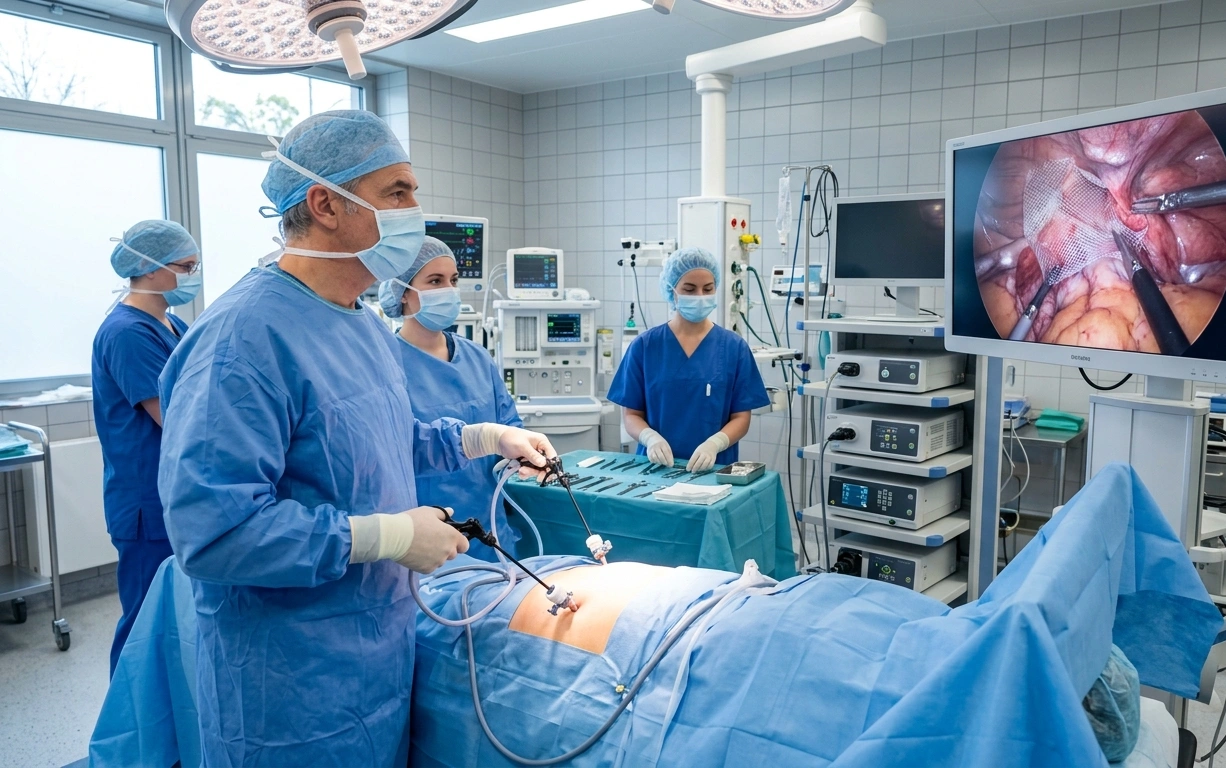
Three small incisions in the lower abdomen. Carbon dioxide gas creates space in the pre-peritoneal cavity for the surgeon to work. HD camera goes in. The hernia defect is identified, the sac reduced, the pre-peritoneal space dissected precisely, navigating the anatomy carefully, preserving the nerves and vas deferens.
Mesh is placed flat over the defect and the surrounding weak area. It’s held in position by the surrounding tissue pressure, no staples in most TEP cases, which reduces the risk of chronic groin pain from staple-related nerve entrapment. The gas is released. Incisions closed.
Total operative time, 45 to 60 minutes for a unilateral repair. Bilateral, both sides in one sitting, typically 60 to 90 minutes.
You wake up sore. That’s honest. But mobile. Walking the same evening. Discharged within 24–48 hours.
Recovery After Inguinal Hernia Surgery
Groin repairs have a specific recovery pattern, different from upper abdominal hernias.
Days 1–3 soreness in the groin, pulling sensation when walking, mild swelling. Normal. Walking is encouraged. Pain managed with oral medication. Ice packs help with swelling.
Week 1 significantly more comfortable. Most patients are managing daily life at home. No driving while on pain medication. Lifting restricted to 2kg.
Weeks 2–3 return to desk work and light daily routine. Groin soreness mostly resolved. Energy back.
Week 6 surgical clearance for most laparoscopic hernia surgery in Hisar patients. Physical work, exercise, lifting, all return. The mesh has integrated. The repair is holding.
One thing specific to inguinal repair, some men notice mild scrotal swelling or bruising in the first week. Alarming-looking, not clinically significant, resolves on its own. Worth mentioning to your surgeon at the one-week follow-up regardless.
Prevention After Repair
Surgery fixes the hernia. Reducing recurrence risk is the patient’s part of the job.
- Follow the six-week activity restriction without exception, the mesh needs time
- Treat the underlying pressure factors, constipation, chronic cough, obesity
- Lift correctly going forward, bend at the knees, brace the core, no sudden jerking movements
- Maintain a healthy weight, sustained abdominal pressure is the recurring underlying factor
- Attend both follow-up appointments, one week and one month
Conclusion
Inguinal hernia isn’t something that resolves on its own or stays small indefinitely. It grows. Gets more symptomatic. Eventually it becomes an emergency if it strangulates. The better version of this story, the one with a planned procedure, smooth recovery, and no complications, starts with a consultation now rather than an emergency later.
Laparoscopic inguinal hernia surgery in Hisar at Meyash Hospital is precise, well-supported, and guided by a surgeon who has done enough of these to make even the complex ones look manageable. Book the consultation.
Book Your Inguinal Hernia Surgery at Meyash Hospital, Hisar
Don’t wait for a straightforward hernia to become a complicated one. Meyash Hospital offers expert laparoscopic inguinal hernia surgery in Hisar with advanced technique, real post-operative care, and Dr. Yashpal Singla’s experienced hands. Book your consultation today.
Frequently Asked Questions
Q1: How much does laparoscopic inguinal hernia surgery cost?
Cost varies based on hernia complexity, whether the repair is unilateral or bilateral, anaesthesia type, and length of stay. Meyash Hospital offers transparent pricing discussed during your pre-surgical consultation. Generally, laparoscopic repair costs more than open surgery upfront but delivers better recovery outcomes and lower long-term recurrence costs.
Q2: What type of surgeon is best for inguinal hernia repair?
A general or laparoscopic surgeon with significant specific experience in inguinal hernia repair, particularly TEP technique for laparoscopic cases. Volume matters here. The inguinal anatomy is complex and navigated instinctively by surgeons who operate in it regularly.
Ask directly how many inguinal repairs they perform annually and whether they handle recurrent cases.
Q3: Can both inguinal hernias be repaired at the same time?
Yes, bilateral inguinal hernia repair through the same three laparoscopic incisions is one of the genuine advantages of the TEP approach. Both sides are repaired in a single anaesthetic sitting, typically 60–90 minutes. Recovery is no longer than for a unilateral repair, making it significantly more practical than two separate operations.
Q4: How soon can I return to physical work after inguinal hernia surgery?
Six weeks from laparoscopic repair before returning to physical or manual labour. This isn’t conservative caution, the mesh integration timeline is biological, not negotiable. Returning to heavy physical work before six weeks is one of the most common reasons for hernia recurrence after a technically successful repair.
Q5: Will inguinal hernia surgery affect fertility or sexual function in men?
Laparoscopic TEP repair, when performed by an experienced surgeon, carries a very low risk of vas deferens or testicular blood supply injury, significantly lower than open repair for the same hernia. The vas deferens is identified and carefully preserved throughout the procedure. Discuss specific concerns with your surgeon during the pre-operative consultation.
Q6: What is the recurrence rate for laparoscopic inguinal hernia repair?
Recurrence rates for laparoscopic inguinal hernia repair are low, typically 1–3% at five years in experienced hands, compared to slightly higher rates for open repair. Risk of recurrence increases with mesh quality, surgical technique, bilateral involvement, and whether post-operative activity restrictions are followed during the six-week integration window.

