
Introduction
Understanding laparoscopic vs open surgery is important because both surgical approaches affect recovery time, pain levels, hospital stay, and overall patient outcomes.
That gap — between the consultation room and real understanding — is what this post is trying to close.
Because the choice between laparoscopic vs open surgery isn’t just a technical one. It affects how long you’re in the hospital, how much pain you’re in, when you can go back to work, what your scar looks like, and in some cases, the risk of complications. Those are real things. Worth understanding properly.
This isn’t a case for one over the other. Both have their place. But you deserve to know the actual differences. Before choosing between surgical options, it’s important to clear common misconceptions. You can read more about laparoscopy surgery myths you should know here.
Laparoscopic vs open surgery are two different surgical approaches used to treat various medical conditions. Laparoscopic surgery involves small incisions, faster recovery, and less pain, while open surgery requires a larger incision but may be necessary for complex or emergency cases. Choosing the right method depends on the patient’s condition, surgeon’s expertise, and overall health.
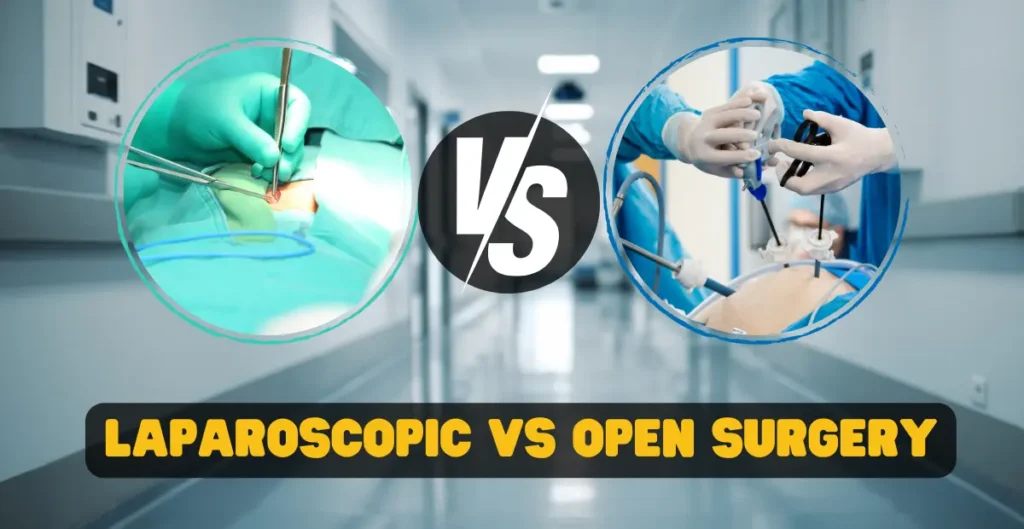
Laparoscopic vs Open Surgery: What’s the Real Difference?
To understand laparoscopic vs open surgery, it is important to know what actually happens during each procedure.
In laparoscopic vs open surgery, the surgeon makes a single large incision — sometimes 15 to 20 cm — to directly access the organ or area being operated on. They can see everything with their own eyes, touch tissue, feel for abnormalities. It’s the approach that surgery was built on, and it’s still the right choice in many situations.
In laparoscopic vs open surgery, the surgeon makes several tiny incisions — usually 0.5 to 1.5 cm — and works through a camera and instruments on a screen. The view is magnified, sometimes more detailed than the naked eye. But it requires specific training and a different kind of spatial thinking.
Neither is inherently better. The right approach depends on the condition, the patient, and the surgeon.
Benefits of Laparoscopic Surgery Over Open Surgery
When comparing laparoscopic vs open surgery, laparoscopic procedures offer several advantages in suitable cases.
When laparoscopic surgery is appropriate, the advantages over open surgery are meaningful:
• Pain — significantly less post-operative pain because the incisions and muscle disruption are so much smaller
• Hospital stay — often one night or less versus three to seven days for open procedures
• Recovery time — most patients return to light activity in one to two weeks; open surgery recovery is typically four to six weeks
• Infection risk — much lower because less wound surface is exposed
• Blood loss — laparoscopic procedures involve significantly less blood loss in most cases
• Scarring — small, fading marks versus a prominent long scar
• Internal adhesions — less tissue handling means lower risk of internal scar tissue forming later
For someone in Hisar managing work, family, and daily life — these differences translate into real time and real quality of life.

When Open Surgery Is the Better Choice
In the discussion of laparoscopic vs open surgery, open surgery is sometimes the safer and more effective option.
This is the part that sometimes gets left out. Open surgery is not an inferior version of laparoscopic. In certain situations, it is the correct and safer choice. In some cases, conditions like hernia can also be confused with digestive issues, so understanding the difference between them is important. You can read more about hernia vs acid reflux here.
Open surgery may be preferred or necessary when:
• The surgery is an emergency with active bleeding or perforation requiring immediate direct access
• The anatomy is severely distorted by previous surgeries, tumours, or advanced disease
• The surgeon needs to feel tissue directly — for complex cancer surgeries, for example, tactile feedback matters
• Laparoscopic equipment or trained laparoscopic surgeons are unavailable in the facility
• The procedure is too complex to safely complete through small incisions
A skilled surgeon will tell you honestly when open surgery is the right call. Be cautious of anyone who presents one approach as always superior.
Comparing Risks — Laparoscopic vs Open Surgery
Understanding risks is essential when evaluating laparoscopic vs open surgery for any medical condition.
Both approaches carry surgical risks. The difference lies in the type and likelihood.
Laparoscopic surgery risks include:

• Injury to surrounding organs during instrument insertion — rare but possible, especially in complex cases
• Gas embolism from the CO2 used to inflate the cavity — very rare
• Port-site complications — infection or hernia at the small incision sites
• Conversion to open surgery if complications arise mid-procedure
Open surgery risks include:
• Wound infection — higher rate due to larger exposed area
• Significant blood loss
• Internal adhesions that can cause problems like bowel obstruction years later
• Longer anaesthesia time in complex procedures
• Slower healing, particularly in diabetic patients or the elderly
For most elective procedures, the overall risk profile favours laparoscopic surgery in suitable candidates. But in emergencies or complex disease, open surgery may carry lower overall risk by giving the surgeon better control.
Recovery Compared — The Real Numbers
This is often what matters most to patients. Here’s how recovery typically compares between laparoscopic vs open surgery for similar procedures:
• Hospital stay: Laparoscopic — 1 to 2 days. Open — 3 to 7 days
• Return to light activity: Laparoscopic — 1 to 2 weeks. Open — 4 to 6 weeks
• Return to full work: Laparoscopic — 2 to 3 weeks. Open — 6 to 8 weeks
• Pain medication requirement: Laparoscopic — usually short-term mild analgesics. Open — stronger and longer-term pain management needed
• Scar healing: Laparoscopic — small marks mostly faded in 3 to 6 months. Open — full scar healing over 12 to 18 months
These are general ranges. Your specific procedure, your body, and your surgeon’s skill all affect these numbers.
How to Decide What’s Right for You
The honest answer is: this decision belongs to you and your surgeon together. But here are the questions worth asking before you agree to either approach:
• Is this procedure routinely done laparoscopically, or is my case unusual in some way?
• What is your experience with the laparoscopic version of this specific procedure?
• What would make you switch to open surgery during the procedure?
• What are the recovery differences for my specific case, given my age and health?
• Is there a risk of complications that would make open surgery safer for me?
A confident, experienced surgeon in Hisar will answer these questions clearly. If you’re getting vague answers, it’s reasonable to seek another opinion.

Conclusion
The laparoscopic vs open surgery question isn’t a competition. It’s a clinical decision that deserves real information, not assumptions. Laparoscopic surgery offers genuinely better recovery for most patients in most elective situations. Open surgery remains the gold standard when the situation demands it.
Know your options. Ask your questions. And make the decision with full information rather than just going along with whatever’s recommended without understanding why.
Frequently Asked Questions
1. Is laparoscopic surgery less painful than open surgery?
Yes, generally. Because the incisions are much smaller and there is less muscle cutting, post-operative pain is significantly lower after laparoscopic surgery. Most patients need only mild pain relief, compared to stronger medications often required after open surgery.
2. Can all open surgeries be done laparoscopically?
No. While the range of laparoscopic procedures has expanded significantly, not all surgeries can or should be done this way. Certain complex, emergency, or anatomically challenging cases still require open surgery for safety reasons.
3. Is laparoscopic surgery more expensive than open surgery?
The procedure itself may have a similar or slightly higher cost, but laparoscopic surgery often results in overall lower costs because of shorter hospital stays, less medication use, and faster return to work.
4. What happens if my laparoscopic surgery needs to be converted to open?
The surgeon will make a larger incision and complete the procedure the traditional way. This is not a complication — it’s a clinical safety decision. Recovery after conversion follows the open surgery timeline.
5. How do I know if a surgeon in Hisar is experienced in laparoscopic procedures?
Ask directly. Ask how many of the specific procedure they perform per year, what their conversion rate to open surgery is, and whether the hospital has modern laparoscopic equipment. These are entirely reasonable questions to ask before any surgery.

